
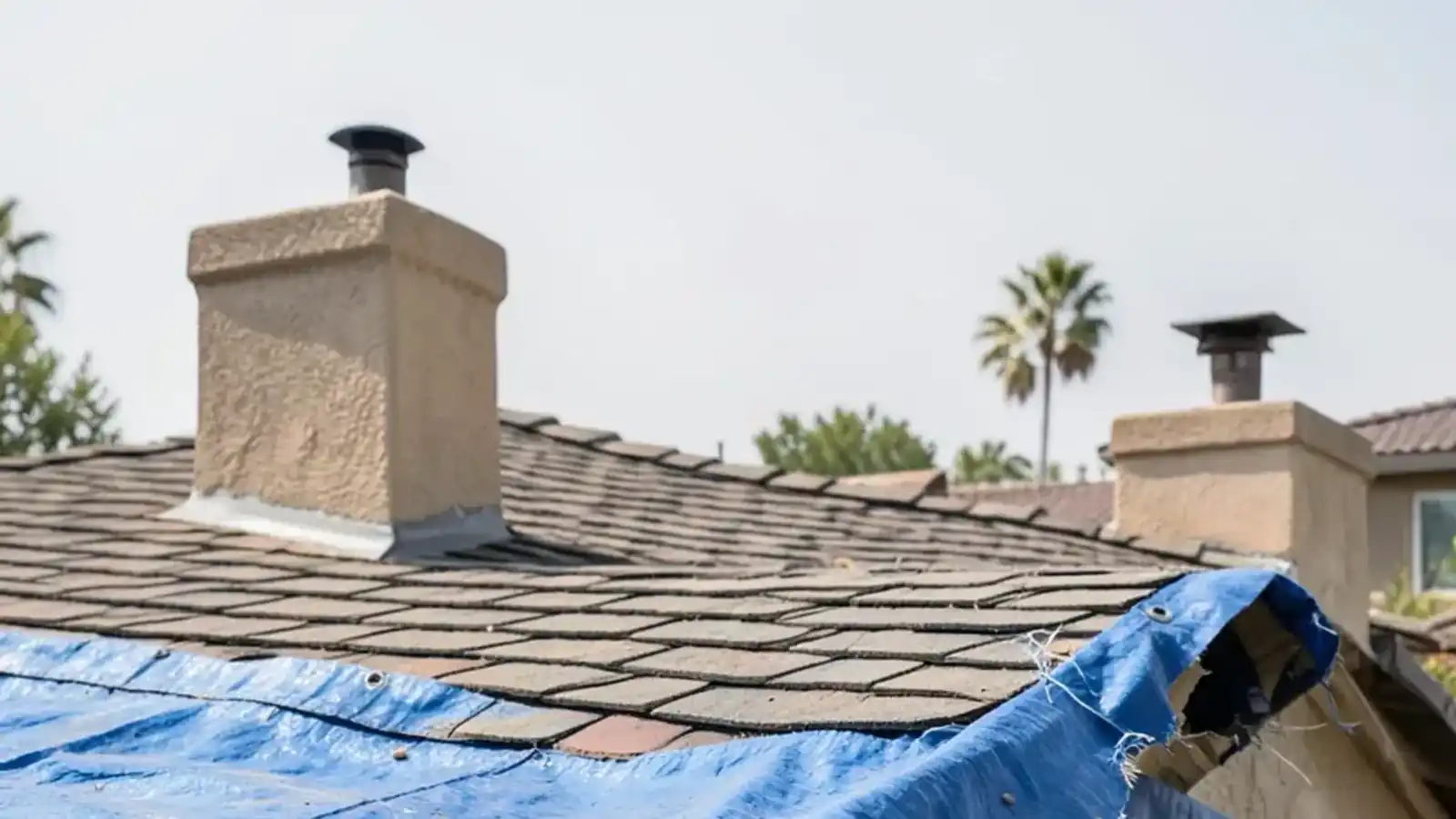
Emergency Roof Repair
Emergency Roof Tarping: What It Covers and How Long It Lasts
A roof tarp is a short-term cover, and how long it lasts depends on wind, sun and how it is fastened. Many hold for a few weeks, and a poor one can fail in days. Plan the permanent repair as soon as the roof is dry and materials are ready.
- ★ 4.9 on Google · 69 reviews
- Same-day or next-day bookings
- Based in Van Nuys, CA
Published and updated November 3, 2026 · By the Clear Shield Roofers team, Van Nuys, CA
On this page
- What decides how long a roof tarp lasts
- What a tarp does and does not cover
- How roofers put a tarp on so it stays
- Signs a roof tarp is failing
- What roofers weigh before choosing a cover
- Why tarp prices vary from roof to roof
- Is roof tarping covered by insurance
- When a tarp is the wrong tool
- Next steps after the tarp goes on in Los Angeles
- Common questions
Most tarps outlast the storm that put them there, and few outlast the season. If you want a short answer to how long a roof tarp lasts, plan on weeks, not months. The real limit is not the fabric. It is the wind, the fastening and the roof underneath.
That makes tarping a bridge. It keeps rain out while the damage is assessed, the claim is opened and materials are ordered. Our emergency roof tarping service is built around that bridge, and the sections below explain how to use it well.
What decides how long a roof tarp lasts
No one can honestly print a number for every roof. These factors move the answer more than anything else:
| Factor | Longer life | Shorter life |
|---|---|---|
| Fastening | Battens screwed into framing | Nails or staples through the fabric |
| Wind exposure | Sheltered slope, tight edges | Ridge or hillside, loose edges |
| Sun | Heavy-duty tarp, short time | Thin tarp, many sunny weeks |
| Pooling | Smooth slope, water sheds | Sagging pockets that hold water |
| Roof underneath | Sound deck and framing | Soft deck, broken rafters |
| Follow-up | Checked after each storm | Left alone and forgotten |
Los Angeles is hard on thin plastic. Sun is strong most of the year, and Santa Ana wind events can arrive in the same months as the first rains. A tarp that is fine on a calm day can start flapping on the first gusty night.
What a tarp does and does not cover
A tarp covers an area. It does not repair anything. It will not close a hole in the deck, replace a missing tile or dry out wet insulation. It slows water, and that is all it is meant to do.
It also does not suit every roof. Tile roofs, steep slopes and wet surfaces change what is safe. Some damage is better handled by a quick patch with underlayment, the waterproof layer under the roof surface, and a plan to return. We assess the roof first and tell you which option fits.
How roofers put a tarp on so it stays
Hands-on tarp work is mostly about the edges. A tarp that is only nailed through the fabric tears at each hole. Our approach to an emergency cover looks like this:
- Clear the area. Remove loose debris and sharp pieces that would cut the tarp.
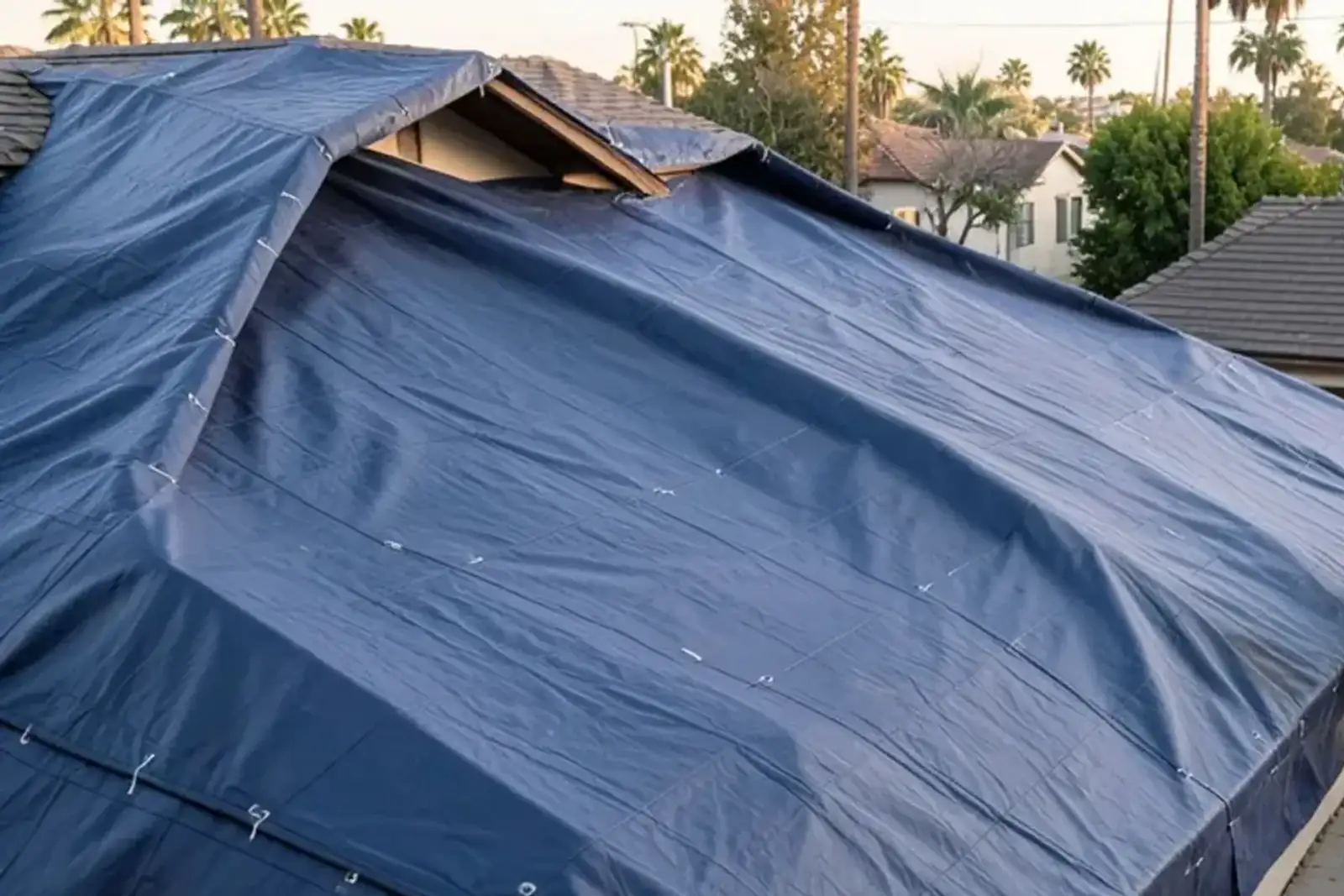
- Cover past the damage. Carry the tarp well above the opening and over the ridge when we can, so water cannot run behind it.
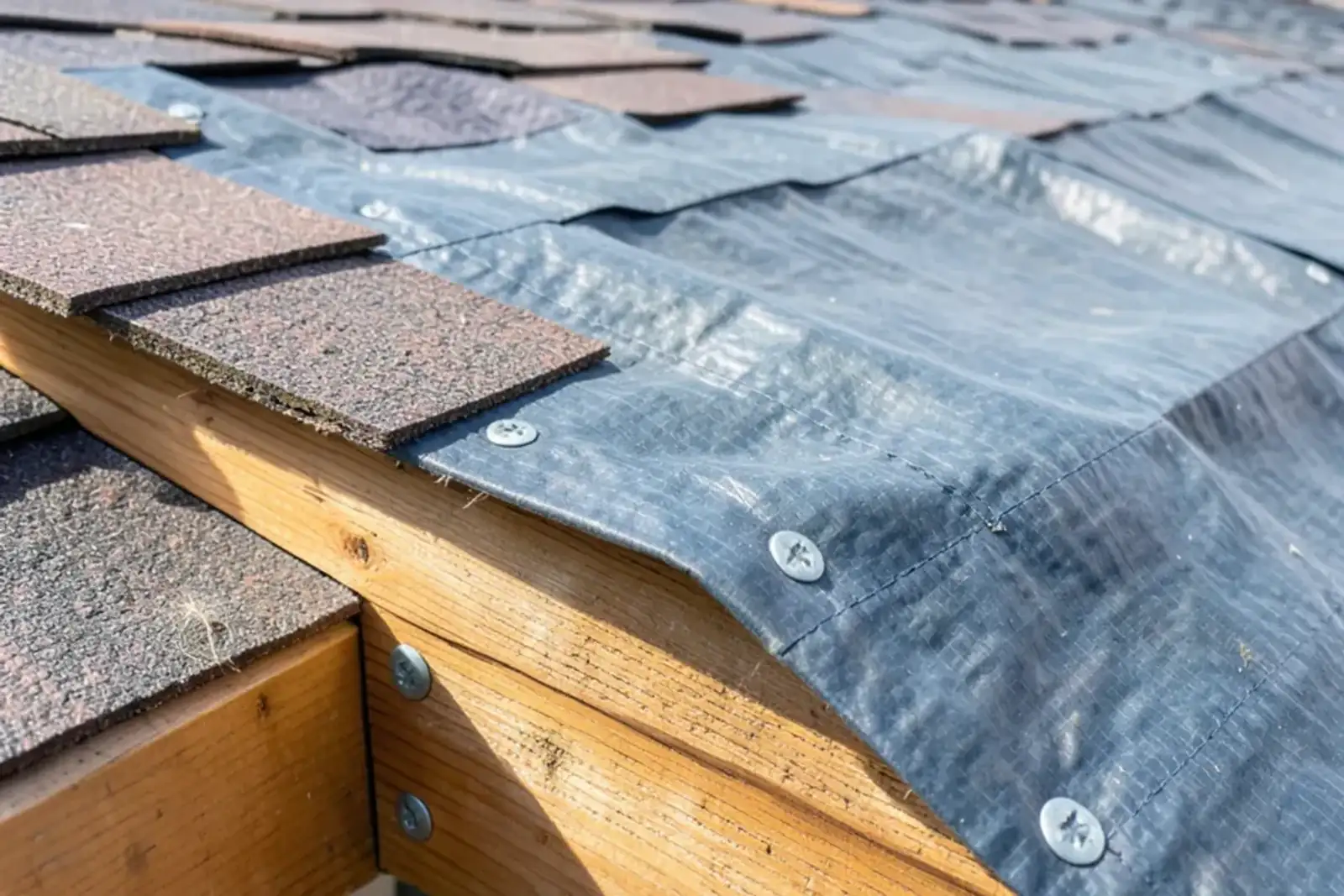
- Lap it correctly. Upper edges go over lower ones, like shingles, so water sheds off.
- Fasten with battens. Fold the fabric over a wood strip and fasten the strip into framing or the deck.
- Pull it tight. Slack collects water and flaps in wind.
- Photograph it. Record the damage and the cover for the claim.
One reviewer in Van Nuys describes the crew as ready to tarp right away during a job. We would approach any emergency cover the same way, and the schedule decides how soon we can arrive.
Signs a roof tarp is failing
Check the tarp from the ground, never from the roof, after every gust and every rain. These signs mean it needs attention:
- Sagging pockets that hold water, which add weight and stretch the fabric
- Flapping or lifted edges, which pull fasteners loose and let rain run underneath
- Tears or frayed grommets, usually at corners and along the ridge
- Slid or bunched fabric, which leaves the damaged area uncovered
- A new or growing stain inside, the surest sign water is getting past
- Sun-faded, chalky fabric, which tears far more easily than new material
Any one of these is a reason to call. A tarp that failed overnight is worth reporting even if the ceiling is still dry.
What roofers weigh before choosing a cover
Every tarp job is a trade-off, and these are the ones that come up most.
Battens or no battens. Fastening a strip over the folded edge holds a tarp far better than nails through the fabric. The cost is screw holes in the deck, which the permanent repair has to seal. We think that trade is worth it in Los Angeles wind, and FEMA's own blue roof work uses wood strips for the same reason.
Cover the whole slope or just the damage. A small tarp is quicker and cheaper but lets water run behind its upper edge. A longer tarp carried over the ridge is harder to place and catches more wind. For a wide opening we prefer to go long, and for a single cracked tile a patch of underlayment may do.
Tarp a tile roof or not. Tile is brittle and slick, and a heavy tarp can crack what is already loose. Sometimes the safer first move is to pull a few tiles, lay underlayment and plan the repair.
Leave it a week or fix it now. If the deck is sound and materials are available, a quick repair beats weeks under plastic. If the insurer needs to see the damage first, the tarp buys that time.
Operation Blue Roof, the federal program that places plastic sheeting on storm-damaged homes, runs only after declared disasters and for primary residences with standard shingled roofs, according to FEMA. Do not plan on it for an ordinary Los Angeles storm.
Why tarp prices vary from roof to roof
We do not publish tarp prices, because they depend on the roof. Size and slope matter most, along with the roof surface, how many stories the home has and how difficult the access is. A simple cover over one slope is a different job from a wrapped hip roof with a chimney.
Plan for the permanent repair, too. A tarp is one cost, and the repair that follows is the larger one. We give a written estimate after we see the roof. Ask any contractor for the scope, the price and the start date in writing.
Is roof tarping covered by insurance
Most policies expect a homeowner to protect the property from further loss, and a tarp is a common way to do that. Whether your insurer pays depends on the cause of the damage and the policy terms. Some key habits:
- Photograph the damage before the cover goes on.
- Keep the invoice, the photos and any dated notes.
- Ask your insurer before you commit to repairs beyond emergency steps.
- Know that claim negotiation is for you or a licensed public adjuster, not the roofer.
We can inspect the roof, document it and write a repair estimate for your insurer. California's contract rules help after a storm. A down payment is limited to $1,000 or 10% of the contract price, whichever is less, and you generally have at least three business days to cancel, with a longer window for disaster repairs. The California Department of Insurance also advises against paying in cash and against final payment before the building department signs off.
When a tarp is the wrong tool
Some damage needs a different first step. If the ceiling is sagging, stay out of that room and call for help. If a tree has hit the framing, the structure may need support before a tarp is safe to place. A roof covered in ash or heavy debris may need cleaning first.
Glendale reaches from the Valley floor up into the Verdugo Mountains, and a hillside slope sees more wind than a flat lot, so we look at exposure as well as damage. We work from Van Nuys and cover Glendale. We will tell you plainly when a tarp is a stopgap and when it is not enough.
Next steps after the tarp goes on in Los Angeles
Once the cover is on, the clock is the permanent repair. Ask for the scope, price and start date in writing, and book the repair before the next storm season rather than after it. Our emergency roof leak repair and storm damage roof repair pages describe how we would assess what is under the cover. If a leak is still active, our guide to a roof leaking in a storm covers the first steps inside.
Roof open to the weather in Los Angeles? Call (209) 563-1278, describe the damage, and we will set the earliest visit we can.
Quick answers
How often should I check a roof tarp after it goes on?
Check it from the ground after every wind event and every rain, and look for sagging pockets, flapping edges, tears at the grommets or a new stain inside. In Los Angeles that often means a look after each Santa Ana gust and each winter storm. If anything has moved, call the roofer who placed it rather than climbing up to re-fasten it yourself.
Can I put a tarp on my own roof?
It is possible, but it is one of the more dangerous homeowner jobs. Tarping means working on a slope that is often wet, near damaged framing, with wind pulling at the fabric. A fall costs far more than a ceiling. Photograph the damage from the ground, catch water inside and have a roofer place the cover from a safe position.
Can a roof tarp be left on for months?
It should not be. Sun breaks down tarp fabric, and wind works at every fastener. A tarp left through a season often frays, loosens or pools water, and that can cause more damage than it prevented. Treat it as a bridge to the repair. If materials or insurance approval are slow, ask the roofer to check and re-secure the tarp.
Does a roof tarp stop all leaks?
No. It sheds most rain from the area it covers, but water can still get in at the edges, at fastener points or where the tarp meets a ridge, chimney or vent. A tarp is only as good as the roof beneath it. If the deck is soft or the framing is damaged, the area may need more support before anything holds.
Is roof tarping covered by insurance?
Often the cost is claimed as part of a covered loss, because most policies expect you to take reasonable steps to prevent more damage. Your policy decides. Keep photos from before the tarp goes on, keep the invoice and ask your insurer what it requires. Do not assume a tarp for old wear will be covered.